Saturday, 8 August 2015

Coronation Beers (part two)

Did only a handful of brewers produce a coronation beer? Not if surviving labels are anything to go by.

On The Labologist's Society webpage there are 154 examples from 147 breweries. Admittedly a couple are foreign. But that’s still quite a lot. To do my favourite thing, contextualise that, there were 501* breweries in the UK in 1953. Meaning around a third brewed – or at least marketed – a beer for the coronation.

Here’s a list of those beers:

Coronation Beers
Brewery Beer
Abington Brewery Co Ltd Coronation Ale
Adnams & Co Ltd Coronation Ale
James Aitken & Co Coronation Ale
Alton Court Brewery Co Ltd Queens Ale
Ballingall & Son Ltd Coronation Ale
Barclay Perkins & Co Ltd Russian Imperial Stout
Barnsley Brewery Co Ltd Royal Strong Ale
Charles Beasley Ltd Coronation Ale
Benskins Watford Brewery Ltd Coronation Ale
Bent's Brewery Co Ltd Coronation Ale AI
Bentley & Shaw Ltd Regalia Ale
Bentleys Old Brewery (Rotherham) Ltd Elizabethan Ale
Bentley's Yorkshire Breweries Ltd Coronation Ale
T & J Bernard Ltd Coronation  Heavy Ale
T & J Bernard Ltd Coronation  Light Ale
Beverley Brothers Ltd Coronation Ale
Birkenhead Brewery Co Ltd Coronation Ale Double Strong
Border Breweries Ltd Crown Ale
W H Brakspear & Sons Ltd Coronation Ale
Brickwood & Co Ltd Coronation Ale
Bristol Brewery George & Co Ltd Coronation Stout
The Broadway Brewery Ltd Coronation Ale
Matthew Brown & Co Ltd  Coronation Bitter Beer
Matthew Brown & Co Ltd  Kings Ale
Brutton Mitchell Toms Ltd Coronation Ale
Burtonwood Brewery (Forshaws) Ltd Loyalty Ale
Bushell Watkins & Smith Ltd Coronation Ale
William Butler & Co Ltd Coronation Ale
J W Cameron & Co Ltd Sovereign Stout
Campbell Praed & Co Ltd Coronation Brew
Carlsberg Brewery Ltd Royal Lager
Carlise & District State Management Brewery Crown Ale (naturally matured in bottle)
R. F. Case & Co Ltd Elizabethan Ale
Castletown Brewery Ltd Queen's Ale
Catterall & Swarbrick Ltd Queen's Ale
The Ceylon Brewery Ltd Coronation Ale
Charrington & Co Ltd Royal Toby Ale
Richard Clarke & Co Coronation Ale
Cobb & Co Ltd Crown IPA
Cobbold & Co Ltd Coronation Pale Ale
Dale & Co Ltd Coronation Ale
Daniell & Sons Ltd Coronation Ale
James Deuchar Ltd Coronation Ale
Robert Deuchar Ltd Coronation Ale
J A Devenish & Co Ltd Coronation Beer
Drybrough & Company Ltd '53 Ale
Dudgeon & Co Ltd Coronation Ale
Dunmow Brewery Ltd Coronation
Dutton's Blackburn Brewery Ltd Coronation Ale
East African Breweries Ltd Coronation Ale
East African Breweries Ltd Simonds Coronation Lager
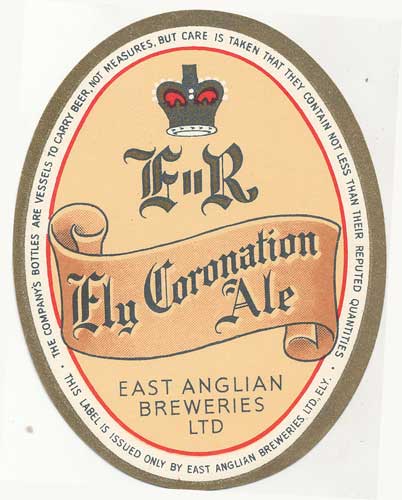
East Anglian Breweries Ltd Ely Coronation Ale
Eldridge Pope & Co Ltd Coronation Ale
Ely Brewery Co Ltd Ely Coronation Ale
Evan Evans Bevan Ltd Silver Crown Ale
Felinfoel Brewery Co Ltd Coronation Ale
Fremlins Ltd Queens Ale
Friary Holroyd & Healy's Breweries Ltd Sovereign
Sidney Fussell & Sons Ltd  Coronation Ale
Sidney Fussell & Sons Ltd  Coronation Stout
Gibbs Mew & Co Ltd Coronation Beer
Gordon & Blair (1923) Ltd Coronation Strong Ale
Greene King & Sons Ltd Coronation Ale
John Groves & Sons Ltd Coronation Ale
Groves & Whitnall Ltd Coronation Ale
Hall & Woodhouse Ltd Coronation
Julia Hanson & Sons Ltd Coronation Ale
Harman Uxbridge Brewery Ltd Coronation Ale
Harvey & Son Elizabethan Ale
G S Heath Ltd Coronation Ale
J W Hemingway Ltd Coronation Ale
J Hey & Co Ltd Coronation Ale
S H Higgs Ltd Double Lion Pale Ale
Higson's Brewery Ltd Coronation Ale
Holden's Brewery Ltd Coronation Stout
Holt Brothers Ltd. Coronation Ale
Hope & Anchor Breweries Ltd Royal Jubilee Stout
The Hull Brewery Co Ltd Coronation Ale
Hyde's Anvil Brewery Ltd Anvil Brand Pale Ale
Hyde's Anvil Brewery Ltd Pale Ale the Family Anvil
Ind Coope & Allsopp Ltd Commonwealth Ale
Jennings Brothers Ltd Coronation Ale
John Joule & Sons Ltd Coronation Ale
Kemp Town Brewery Brighton Ltd Coronation Ale
Lancashire Clubs Brewery Ltd Queens Ale
Leeds & Wakefield Breweries Ltd Coronation Regal a Strong Ale
Marston Thompson & Evershed Ltd Coronation Ale Dark Strong
Matthews & Co Coronation Ale
Mauldon & Sons Coronation Ale
McLennan & Urquhart Ltd Coronation Ale
McMullen & Sons Ltd Coronation Ale
Meux's Brewery Co Ltd Coronation Treble Gold
Mitchells & Butler Ltd Coronation Ale
Moors & Robsons Breweries Ltd Coronation Ale
J & J Morison Ltd Coronation Ale
Morland & Co Ltd Monarch
Morland & Co Ltd Queen's Toast
Morrells Ltd Coronation Ale
William Murray & Co Ltd Coronation Ale
William Neesham Ltd Coronation Stout
H Newnam & Sons Ltd Coronation Strong Ale
Nicholson & Sons Coronation Ale
J Nimmo & Son Ltd Coronation Ale
Okell & Son Ltd Coronation Ale
Paine & Co Ltd Coronation Ale
P. Phipps & Co Ltd Double Crown
Portsmouth & Brighton United Breweries Ltd Pompey Royal Coronation Brew
Thos. Ramsden & Son Ltd Old Ram Coronation Brew
Randall's Brewery Ltd Coronation Ale
Rayment & Co Ltd Coronation Ale
David Roberts & Sons Ltd Coronation Ale
Frederic Robinson Ltd Unicorn Coronation Ale
St Austell Brewery Coronation Ale
Scarborough & Whitby Breweries Ltd Queens Ale
Shepherd Neame Ltd Coronation Ale
Shrewbury & Wem Brewery Co Ltd Coronation Ale
H & G Simonds Ltd Coronation Ale
Simonds Farsons Cisk Ltd Crown Ale
Simpsons Brewery Ltd Century Stout
Southams Brewery Ltd Coronation Ale
South London Brewery Ltd Elizabeth 1953
John Smith's Tadcaster Brewery Co Ltd Coronation Ale
Star Brewery Co Ltd Coronation Brew
Starkey Knight & Ford Coronation Ale
Steel Coulson & Co Ltd Coronation Export Ale
Steel Coulson & Co Ltd Coronation Sweet Stout
Strong & Co of Romsey Coronation Ale
Stroud Brewery Co Ltd Coronation Ale
Style & Winch Coronation Brew Barley Wine
Tamplin & Sons Ltd Queens Ale
Taylor Walker & Co Ltd Coronation Ale
Taylor Walker & Co Ltd Coronation Vintage Ale
Tollemache's Breweries Ltd Coronation Ale
Tomson & Wotton Ltd Coronation Ale 1953
Ushers Wiltshire Brewery Ltd Triple Crown
Thomas Usher & Son Ltd Golden Rule
Vallances Brewery Ltd Coronation Ale
Wadworths & Co Ltd Queen's Ale
Peter Walker (Warrington) Ltd Coronation Ale
Warwicks & Richardsons Ltd Coronation
Webbs (Aberbeeg) Ltd Coronation Ale
Samuel Webster & Sons Ltd Old Brown Coronation Ale
Welcome Brewery Co Ltd Loyal Welcome Coronation Ale
Charles Wells Ltd Coronation Ale
Wells & Winch Ltd Coronation Ale
Richard Whitaker & Sons Ltd Coronation Bitter
Whitworth, Son & Nephew Ltd Coronation Ale
Wolverhampton & Dudley Breweries Ltd Coronation Ale Old Ale
Wrekin Brewery Co Ltd Coronation Wrekin Ale
Yorkshire Clubs Brewery Ltd Coronation Beer
Young & Co Brewery Ltd Coronation Ale
J J Young & Son Ltd Coronation Strong Ale
George Younger & Son Highland Ale
Robert Younger Ltd Coronation Ale
Source:
The Labologist's Society http://labology.org.uk/?page_id=1637


You probably noticed that some names were quite popular. I can’t help myself from producing another table. This time breaking the beers down by their names:

Coronation beer names
name number % of total
Coronation 3 1.95%
Coronation Ale 92 59.74%
Coronation Beer 3 1.95%
Coronation Brew 5 3.25%
Coronation + style 10 6.49%
Crown 7 4.55%
Elizabeth 4 2.60%
Queen 9 5.84%
Sovereign 2 1.30%
monarch 1 0.65%
Royal 4 2.60%
other royal related 3 1.95%
style 8 5.19%
other 3 1.95%
total 154
Unsurprisingly, the vast majority included the word “coronation” or another with a royal connection. Kings Ale seems the oddest choice. I’m truly baffled by that one.

Also of interest is the spread of styles. You’d expect Strong Ales, but there are quite a few Stouts and even some Pale Ales and an IPA. Many give no indication of what style they might be.

Next time a brewer will tell us about brewing a Coronation Ale: “best brew since 1914”.


* Brewers' Almanack 1955 p.68.

Friday, 7 August 2015

1990 Eisenach pub guide

Yet another totally useless pub guide. As you may have guessed, it's as much laziness as nostalgia driving this series.

Dolores's mum lived in Eiseanch and we got married there, so I knew the town pretty well.


Eisenach, a town crammed into steep, wooded valleys on the road and rail routes between Frankfurt and Leipzig,   is a good place to enter the DDR and for me to start a description of a few Thuringian towns. Stuck on one of the hilltops around the town is the picturesque medieaval Wartburg castle, where Martin Luther hid out out for a while when things got a bit nasty during the Reformation. The castle has also given its name to the car which is the town's main product. The Wartburg plant and various component factories take up big chunks of the town and contribute, along with all the coal fires, to the rather dirty air. The centre of town, with Bach's birthplace (now a museum) and the market place is reasonably attractive. However, the council has seen fit to demolish a large area of old buildings behind the baroque town hall and intends building modern flats there. The town's brewery is at the start of the road leading up to the castle. A large window gives a good view of the copper, but on the whole the place looks ramshackle and in need of renovation.

Like many places in the DDR, the town centre is short on pubs (one of the few, the Marktschanke on the marketplace is closed for an unspecified period of renovation). But don't let this make you despair - just 5 minutes away from the centre there are plenty,  if you know where to look.

Starting on one of the main squares in town, Platz Deutsch-Sowjetische-Freundschaft (which may well have changed its name by the time you read this) is the hotel Thuringer Hof. When it was built in the days of the German Empire,  it must have been modern, fashionable and luxurious. Now its faded opulence is a good backdrop for anyone wishing to play out their Grand Hotel fantasies. The restaurant is still impressive enough, with its oak-panelling and crystal chandeliers, and is an eminently suitable place for those wanting to dine in style without paying accordingly stylish prices. The prices are, however, towards the upper end of the DDR scale. In keeping with it's upmarket image, it sells Apoldaer Classic instead of usual Eisenacher Pils, of which you'll soon have had more than enough.

Leaving the square along Johannisstr. and crossing Johannisplatz, just a little up the hill on Frauenberg is Gaststatte Wartburghof (Mon, Thu, Sun 15-22; Fri, Sat 15-24; Tue, Wed closed), selling Eisenacher Pils, a cosy private pub of several rooms off a central bar. In both layout and atmosphere it resembles an old Yorkshire corridor pub. Like most of the DDR's private establishments, it has a few more personal decorative touches than the state run HO bars. The beer is served in a wide range of variations on the theme 'straight beer glass'. Some of the glasses, of types not usually seen any more, look ready to take well-earned retirement.

Carrying on up Frauenberg after another small square (which also contains the Bach house) is Rittergasse, on which is Gasthaus Harmonie (10 - 18,  Tue Wed closed),  selling Eisenacher Hell. It's a typical down-to-earth DDR boozer, of the type which seems to act as a substitute factory/school canteen. At lunchtime it's full of schoolkids presenting their school dinner tickets and factory workers tucking into incredibly cheap food served on plastic trays. If you prefer to do your drinking without the company of the local brats, turning up after 13:00 is probably a good idea. Whatever the clientele, the single plain room is always cheerful, friendly and very good value.

Now continue along Friedrich-Engels Straße, an extension of Frauenberg, and in an ornate turn of the century building is Drachenschlucht which sells, as almost everywhere else here, Eisenacher Pils. The name, meaning 'dragon's gorge', comes from a glacial feature close by in the Thuringer Wald and there's a beautifully tacky painting of it (complete with dragon, maiden and St. George type) on the wall inside. There are also a couple of barrel ends and jokey cartoons, of the sort beloved by pub decorators the world over, to brighten the place up. Otherwise, it's a fairly middle of the table sort of HO establishment with the usual low, low prices. Thankfully, it doesn't attract the usual big, big crowds of thirsty drinkers.


Two of the places mentioned above still exist:

Steigenberger Hotel Thüringer Hof
Karlspl. 11,
99817 Eisenach.
Tel: +49 3691 280
http://de.steigenberger.com/Eisenach/Steigenberger-Hotel-Thueringer-Hof


Gaststätte Wartburghof
Frauenberg 12,
99817 Eisenach.
Tel: +49 3691 203053

Thursday, 6 August 2015

Dutch Lager Styles 1870 - 1960 (part nine)

Bokbier in the 1930’s
The Bokbier season wasn’t quite the same as today. Originally it had been released for Lent, but as breweries tried to get theirs out first, the date had moved steadily earlier. By 1939, the date had been set as the end of November by Bond van Nederlandsche Brouwerijen and they policed their members to make sure they didn’t release it too early.

Bokbier had a gravity of around 17.5 Plato and sold for 40 guilders per hl. The amounts sold were quite small and had been falling throughout the interwar period.

Bokbier output of the 7 breweries in Bond van Nederlandsche Brouwerijen 
1929 1930 1931 1932 1933 1934 1935 1936 1937
11,500 11,200 9,900 8,700 7,500 7,000 5,800 6,900 7,100
Source:
letter 7490 of the Bond van Nederlandsche Brouwerijen held in the Amsterdamse Stadsarchief, doscument number 204 - 35.


Oud Bruin
The modern style of Oud Bruin only appeared in the mid 1930’s. It was a low-alcohol, sweet dark Lager of 3 to 3.5% ABV.

There had been an older style with the same, but there was no connection between the two. The older style was genuinely aged beer and was sour.

The new style was introduced to appeal to older drinker in the south of the Netherlands who were used to fairly low-alcohol top-fermenting beers. Oud Bruin was an attempt by the big Lager brewers from the North to find a beer which would appeal to this market. After WW II the focused moved to women as potential Oud Bruin drinkers.*

Amstel and van Vollenhoven, two Amsterdam breweries, were amongst the first to make this new style. Advertisements show both were already brewing it in 1937.

The style has proved remarkably tenacious, hanging on when most minority Lager styles have faded into extinction.


Dortmunder
A minority style not brewed by every Lager brewery. Given that its price was the same as Pilsener, it must have been around 12º Plato in the 1930’s. As more full-bodied style than Pilsener, it’s ABV may have been a little under 5%.

It had been around for a long while: already in the 1860’s a Dortmund brewery was exporting the style to Holland.

Though never hugely popular, it has managed to cling on. Over the last 25 years, Gulpener Dort and Alfa Super Dortmunder are about the only examples I can think of.


* http://dossierhop.nl/verlorenbieren18b/

Wednesday, 5 August 2015

Let's Brew Wednesday - 1950 Adnams XX Mild

Time to look at Adnams other draught beer from 1950, their XX Mild.

Do you know what’s really, really weird about this beer? It’s stronger than it was in 1939. I can’t think of another beer where that statement is true. Why should that be? Because Adnams didn’t brew what I would call a full-strength Mild before WW II. They brewed what I would call a 4d Ale. A low-gravity type of Mild that was the bastard son of WW I’s Government Ale. Adnams had gravity of 1029º, while a standard Mild would have been around 1036º and a strong Mild over 1040º. XX spent most of the war at 1027º before rising to 1030º in 1950.

I quite like the look if the grist. I’ve come across a couple of interesting Mild recipes from the 1950’s. Ones that include some coloured malts like this does. Lees Mild springs to mind. This, with both amber and crystal malts, probably drank above its gravity. Obviously, there was also No.3 invert sugar and caramel to add extra colour and depth of flavour. Plus little bitterness. I’d order a pint if I saw it on the bar.

This was surely also the basis of Adnams Nut Brown Ale. There’s no separate brew of Nut Brown Ale so I assume it was a bottled version of this. It may have been primed differently before bottling, but the basic recipe would have been identical.


I’m going to keep it short again . . . . over to me . . .


1950 Adnams XX
mild malt 5.00 lb 78.43%
amber malt 0.50 lb 7.84%
crystal malt 80L 0.50 lb 7.84%
no. 3 sugar 0.25 lb 3.92%
caramel 0.13 lb 1.96%
Fuggles 90 min 0.75 oz
Fuggles 30 min 0.50 oz
OG 1030
FG 1005.5
ABV 3.24
Apparent attenuation 81.67%
IBU 20
SRM 27
Mash at 148º F
Sparge at 170º F
Boil time 120 minutes
pitching temp 61º F
Yeast WLP025 Southwold

Tuesday, 4 August 2015

DDR pub etiquette

More from the distant past. This time the do's and don't's of DDR boozers.


A couple of notes on DDR pub etiquette. Everywhere is waiter service only and no standing is allowed. Unfortunately chronic staff shortages (made worse by the recent exodus of many catering personnel to the west) mean that there are often insufficient waiters to serve the whole pub. Hence the 'reserviert' ('reserved') and 'bestellt' ('booked') signs sitting on tables which remain unused all day. It's not unusual for half the tables in a pub to be out of action in this way. It's also not a good idea to start moving chairs around from one table to another without asking, as the waiters often take offence (though the recent surge of visitors from the Federal Republic seems to have helped to loosen them up a little in this respect). All of this can make it difficult to find seats (and hence get a drink), especially for a large group of people. The best way around this is to turn up at an off-peak time (i.e. not 12 - 13 or after 21). Also bear in mind that closing time means what it says - it's when the pub will lock it's doors for the night, not last orders. Don't expect to get a drink in the last 15 minutes before closing.

Most pubs and restaurants are run by HO (Handelsorganisation), a state company which runs all types of retail outlets, including shops. The rarer private pubs are generally a little cosier and more personal inside, but have the same low fixed prices as the state enterprises.

Beer prices vary from about .80 M a half litre for hell to around 1.30 M for spezial or bock beers. W. German beer is about 4.00 M a half litre. Meals vary from around 2 - 5 M in a pub to 6 - 15 M in a hotel or posher restaurant. Don't assume that the latter will always assure you higher quality. Often the small and seemingly grotty corner pubs offer much better value in terms of quality and price, though the choice of meals may be limited.

Those intending to travel by rail should note that Deutsche Reichbahn's services are notoriously slow and unreliable. However, due to the lack of a Dr. Beeching there are still innumerable branch lines, making it possible to reach many quite small villages by rail, as long as you're patient. Most stations of any size have a Mitropa or buffet where hot food and drinks (including draught beer) can be purchased. When in a strange town desperate for a beer but unable to find a pub open, the local Mitropa is usually your best bet. They open seven days a week, from the early morning until 11 or 12 at night. But be warned that it seems to be increasingly difficult to obtain bottled beer in stations, so if you want some refreshment during your journey it's best to buy in a few bottles beforehand. On the main express routes the trains often have Mitropa buffet cars selling simple food and bottled beer. On busier trains, these are good for generating despairingly long queues.


That's made me feel all nostalgic. Going to Berlin soon. Noticed that there a recreation of a HO pub called Gaststätte W. Prassnik. Must drop by. I wonder if they have "reserviert" signs? It would be a nice touch.

Monday, 3 August 2015

Dutch Lager Styles 1870 - 1960 (part eight)

Output by style in 1929


Heineken Rotterdam production by type in 1929
type no. of brews size of brew (HL) total amount % of total
Licht 95 440 41,800 14.46%
Donker 48 770 36,960 12.79%
Bayerisch 41 295 12,095 4.19%
Pils 491 395 193,945 67.11%
Bok 21 200 4,200 1.45%
total 696 289,000
Source:
Heineken brewing record held at the Amsterdam Stadsarchief, document number 834-1754.

There’s been a massive change between 1911 and 1929, with Gerste disappearing altogether and Pils dominating production. Pils was around two-thirds of sales with Licht Lager a very distant second. It’s quite a transformation.

Heineken Rotterdam beers in 1930
Beer OG Balling FG Balling app. degree attenuation % ABV Colour kg hop/hl
Pils 12.2 3.8 68.85% 4.7 4 0.21
Licht 9.2 3 67.39% 3.5 3 0.17
Donker 9 3.2 64.44% 3.5 11 0.14
Bayerisch 13 5.45 58.08% 5 14 0.17
Bok 17.6 8.45 51.99% 7.1 15 0.19
Source:
Heineken brewing records held at the Amsterdam Stadsarchief

There are a few significant differences compared to 1911. The colour of Pils has fallen from 6 to 4, while Bayerisch has got slightly darker, going from 13 to 14. The gravity of Pils has fallen from 13.2 to 12.2 but as the FG has also fallen, attenuation and ABV remain similar. The hopping rates are pretty much unchanged.

Gerstebier has disappeared, seemingly replaced by a dark version of Lagerbier.

The sales of all types of beer went into steep decline in the early 1930’s due to the Wall Street crash. Output declined from 2,319,000 hl in 1929 to 1,609,000 hl in 1933 - a fall of 31%. This is how much sales fell at various breweries in the first five months of 1933 compared to the same months the previous year:

Fall in sales of Lagerbier and Fijnbier 1932 - 1933
Brewery Lager Fijn Total
H.B.M. (Heineken) 7.26% 12.83% 11.09%
Amstel 10.46% 16.44% 13.72%
van Vollenhoven 15.31% 15.23% 15.28%
Z.H.B. 14.54% 20.12% 17.32%
Oranjeboom 13.59% 22.52% 18.64%
Source:
Letter from Amstel to the Bond van Nederlandsche Brouwerijen held in the Amsterdamse Stadsarchief, doscument number 204 - 35.

By Fijnbier, I think they mean full-strength Lagers like Pils. Sales were falling off a cliff. How to explain that? The letter-writer suspected it was due to Lagerbier being passed off as Pils in pubs.

Sunday, 2 August 2015

Coronation Beers

There’s nothing like a royal event for generating celebration brews. Jubilees, royal weddings and coronations have all spawned dozens of special beers.

Queen Elizabeth’s coronation in 1953 came just as Britain was starting to drag itself out of the gloom of the immediate post-war years. With gravities had edging up a little and restrictions easing, it must have seemed a good excuse to cut loose with a really strong beer.

But everyone was so optimistic.

CORONATION BEER
A limited number of brewers are brewing high-gravity beers for the Coronation.

Most brewers would like to have a special beer available for the Coronation, but as sales  will be limited, it is not a practicable proposition, so far as many are concerned, to put through a special brew without a great deal of waste. With this in mind, and feeling that under the circumstances some breweries may wish to purchase sufficient quantities of Coronation beer from an outside source, to bottle under their own label, Messrs. Starkey, Knight and Ford, Ltd., Tiverton, Devon, offer supplies, as will be seen from their advertisement published in this issue. In point of fact, they offer supplies in bulk or bottled under customers' own labels.”
"Brewer's Guardian 1953", 1953, page 59.

Nowadays I guess you’d call that arrangement contract brewing. As most breweries had bottling lines then, I suspect most would have taken it in bulk and bottled themselves. Bound to have been cheaper.

The author takes a very pessimistic view of the opportunities for a coronation beer:

“That a large number of brewers will not be brewing a Coronation beer is due to a wide variety of considerations, but indifference is certainly not one of them. The pros and cons of producing  Coronation beer were discussed in our January issue, when "Country Brewer" the contributor of the article, left the reader in no doubt as to the technical and other problems involved. Apart from the problems dealt with by "Country Brewer" other considerations which have led to decisions against a Coronation brew include (1) Indications that certain sections of the retail trade would not welcome the handling of yet another high-priced speciality; (2) That several "strong" beers were already being marketed and that coming so soon after the production of "Festival" ales and stouts, another would be unlikely to meet with success.”
"Brewer's Guardian 1953", 1953, page 59.

Basically no-one really wanted another strong, expensive beer. The Festival beers he mentioned were ones brewed for the Festival of Britain, which took place in the summer of 1951. There were indeed beers brewed for it, though I only have an analysis of one brewed by Barclay Perkins.

Now the author has a moan about the price of a coronation beer and the costs associated with brewing it:

“Some of the Coronation beers being produced, to sell probably at 1s. 6d., 1s. 9d., or 2s. per nip bottle, will be of 80° to 90°. At those prices which, on the face of them, may seem sufficiently remunerative, there is that bewitching item of "overheads" to be added, plus the cost of nip bottles, which raises the consideration of what use they can be put to next.

The choice of materials for the production of a Coronation beer is fairly simple—they must be of the best. There is scope, however, for the choice of hops of maximum P.V., since aroma and flavour are completely masked by the other constituents of an extra heavy beer.

The excessive Duty towers above material costs, and when that has been fully considered, one can weigh the possibility of making a profit against the probability of cutting a loss.”
"Brewer's Guardian 1953", 1953, page 59.

Not sure why he thinks brewers would have to buy in nip bottles especially for their coronation beer. Lots of breweries already packaged beer in nips. And not only really strong ones. The Whitbread Gravity Book usually mentions the bottle size. These are the breweries who according to that used nips in 1952 and 1953:

Bass, Barclay Perkins, Courage, Hammonds, Ind Coope, McMullen, Watney, Wenlock, Aitchison, Aitken, Alnwick Brewery, Ballingall, Barnard, Bentley's Yorkshire Brewery, Blair, Brickwoods, Bullard, Castletown, Catterall & Swarbrick, Chester Brewery, Cobbold, Bellhaven, Ely Brewery, Everards, Felinfoel, Flowers, Friary Holroyd, Fullers, Gordon & Blair, Guinness, Harman's, Hay, Holt Bros., Hunt Edmunds, Hydes, J Fowler, James Hole, Jeffrey, John Joule, John Smith, John Wright, JW Green, Maclachlan, Masseys, McEwan, Meux, Morgans, Morgans, Morrell, Norman & Pring, Octagon Brewery, Plymouth Breweries, Rose, Russells & Wrangham, Russell's, Scarborough & Whitby, Simonds, St. Austell, Star Brewery, Steel Coulson, Steward & Patteson, Tamplin, Taylor Walker, Tennent, Tetley, Threlfalls, Tollemache, Truman, Usher, W Murray & Co, WA Smith & Sons, Wards Ltd, Whitaker & Son, Young & Co, Younger Geo., Younger Robert, Younger Wm., Youngs Crawshay & Youngs.

Looks to me like his argument about nip bottles is bollocks.

His point about it not mattering which hops you used sounds equally dubious. He’s about right about the selling price, though 2s is on the high end when I look at beers of 1080-1090º in the Whitbread Gravity Book for 1953.

Next time we’ll see how many breweries did make, or at least market, a coronation beer.

Saturday, 1 August 2015

The beers and breweries of Thuringia (25 years ago)

Here's another installment of possibly the most useless guide ever. To part of a country that no longer exists.This time it's an overview of some of the breweries and their beers.

Thank god for Peter Crombecq. I'd picked up a copy of his book "Biersmaken" when I moved to Amsterdam in 1988. My main reason for buying it was that it had a complete list of Belgian beers. But it also contained a section on objectively tasting beer. It got me intrigued in trying to describe beer flavour and prompted me to start making tasting notes. Which is why I have the brief descrptions in the text below.


Beers
The beers are all bottom-fermented, though the Schmitt brewery in the village of Singen produces a pale top-fermenting beer. Most are unpasteurised and the bottled beer will develop a sediment after 6 to 7 days. They fall into the following general categories:

Hell pale and fairly thin
Pils with a bit more body, often quite bitter
Pilsator a bit darker and more like a true Czech Pils
Spezial a premium Pils, the bottled equivalent of Pilsator
Bock a winter beer (available November to January) of about 16% Balling - can vary in colour from amber to black
Schwarz as the name suggests, a dark lager, similar in style to Czech Tmavé Pivo

The Reinheitsgebot has never been enforced in the DDR, originally due to raw material shortages in the 1950's. Currently, the ordinary pils and hell beers are brewed using about 70% malt and the spezial and bock beers using about 80%. Both use about 10% sugar. Despite this, some of the beers, especially the pilsators, are very characterful and compare favourably with some of the rather inoffensive pils-style beers of the Federal Republic. In fact, with their bitter emphasis, the DDR beers are often more reminiscent of the pale Czech lagers. With the availability of W. German beers in the DDR it is now possible to directly compare the products of the two nations' breweries. In Muhlhausen, for example, beer from Eschwege (about 30km away over the border) is on sale. After a couple of glasses of the excellent local Turmquell Pilsator I tried Eschweger Pils which, although as it proudly proclaimed brewed to the Reinheitsgebot, seemed thin and almost tasteless in comparison.

Breweries
The specific beers, by brewery, in the towns described are as follows:

Vereinsbrauerei Apolda
Classic malty with a strong bitter finish


Eisenacher Brauerei
Hell a bit thin and watery
Wartburg Pils sweetish flavour with a bitterish aftertaste
Bock  amber coloured, pleasantly malty


Braugold Erfurt
Pils a good, clean, very bitter beer
Angerbrau well-balanced and bitter


J. Andreas Klosterbrauerei, Eschwege, Federal Republic
Eschweger Pils neutral flavour with a slight bitter aftertaste


Brauerei Gotha
Pils thin and bitter
Diabetiker malty aroma and bitter, slightly strange, taste
Spezial bitter aroma and bitter taste


Brauerei Jena
Pils light with a bitter aftertaste


Kostritzer Schwarzbierbrauerei, Bad Kostritz
Schwarzbier Black, fairly sweet and malty


Muhlhausen Turmquell (bottled)
Pils light, rounded malt aroma and bitter taste
Spezial hoppy, slightly acidic flavour, with a bitterish finish
Bock slightly sweet, malty flavour with bitter finish


Muhlhausen Turmquell (draught)
Pils pale and quite bitter
Pilsator malty/fruity aroma with strong bitter finish


Brauerei Neunspringe, Worbis
Hell thin with a slight bitter taste
Pils a bit more body and a bitter finish
Pilsator slight malty/fruity aroma with a hop finish


Sternquellbrauerei, Plauen
Pils thinish but bitter
Plaunator bitter beer with a malty aroma and bitter/buttery finish
Pilsator bitter taste with a full spicy, hoppy finish
Bock sweet and dark with a slight caramel finish


Konsum-Brauerei Weimar-Ehringsdorf
Ehringsdorfer Pils thin but pleasantly bitter


Exportbier-Brauerei Wernesgrun
Wernesgruner Pils      malty aroma and bitter aftertaste


The companies listed above are all VEB (Volkseigener Betrieb) or nationalised firms (apart from the Eschwege brewery, of course), but, especially in the south, there are still several very small private breweries operating. Examples of these are the Brauerei Göpfert in Jüchsen, Brauerei Geßner in Steinach and Brauerei Schmitt in Singen (the smallest brewery in the DDR). The best bet for finding the beers from these breweries is probably to visit their home village.


Wasn't that, er, completely useless? While most of the larger breweries have closed, I was delighted to discover that the three small private breweries mentioned in the last paragraph are all still open:

Brauerei "Zur Goldenen Henne"
Queckgasse 17,
98631 Jüchsen.
Tel: 0170/ 6018260
Fax: 036947/ 50903
Email: webmaster@brauerei-juechsen.de
http://www.brauerei-juechsen.de


Privatbrauerei Gessner
Am Lindenbach 27,
96515 Sonneberg.
Email: info@privatbrauerei-gessner.de
Telefon: 03675/4079-0
Fax: 03675/4079-40
http://www.privatbrauerei-gessner.de/


Brauerei Schmitt
Brauereiweg 1,
99326 Ilmtal OT Singen
Tel: 03629-802556
Email: info @ brauerei-schmitt.de
http://www.brauerei-schmitt.de

If you'd like to try the Schmitt beer, the fasmily runs a pub in the village:

Gasthaus Zum Singer Berg
Friedrich Schönheit Str. 4,
99326 Ilmtal.
Tel: 03629-802244
Fax: 03629-8379127

http://www.gasthaus-singerberg.de/