Showing posts with label SSS Stout. Show all posts

Saturday, 18 March 2023

Let's Brew - 1867 Reid Export Treble Stout

I'm done with the IPA recipes, for now. T could be encouraged to do more. Especially if you throw some money my way. Did I mention that I'm currently in a limbo between work and retirement. I haven't officially retired, but I'm neither working nor on the dole.

We're back with London Stout. Because that's what I've been writing loads of: London Stout recipes. For my upcoming super book on the style. I've finished 135 recipes, do far. Which is maybe half way. I really need to crack on if I'm to publish the book by June. Which is my aim.

On with the recipe.

After a quick glance at this beer, I thought it wasn’t worth a recipe of its own. Then I looked at the grist.

The gravity is exactly the same as straight Treble Stout. But the grist is very different. Over 50% of the grist is amber malt. There’s no pale malt at all. Instead, there’s some white malt. But only about 25% of the grist. There’s almost as much brown malt. Less black malt than the other Stouts, mind.

A very similar mashing scheme was employed, however. Three mashes and a sparge. Not sure why it needed to be quite so complicated.

Mash number barrels strike heat tap heat
1 315 168º F 147º F
2 210 178º F 159º F
3 525 173º F 153º F
sparge 490 160º F  

English hops, harvested in 1865 and 1866. Quite a lot of them, too.

At least 12 months ageing with Brettanomyces is required. Maybe more. It is a bit of a beast with all that dark malt.

1867 Reid Export Treble Stout
white malt 5.50 lb 23.91%
brown malt 4.00 lb 17.39%
amber malt 13.00 lb 56.52%
black malt 0.50 lb 2.17%
Goldings 150 min 4.50 oz
Goldings 60 min 4.50 oz
Goldings 30 min 4.50 oz
Goldings dry hops 1.00 oz
OG 1094
FG 1027
ABV 8.86
Apparent attenuation 71.28%
IBU 138
SRM 39
Mash at 153º F
Sparge at 160º F
Boil time 150 minutes
pitching temp 55.5º F
Yeast Wyeast 1099 Whitbread Ale


Wednesday, 5 January 2022

Let's Brew Wednesday - 1881 Whitbread SSS

Fluttering proudly at the top of the Whitbread Black Beer flagpole was SSS. Probably known as Treble Stout. That’s the way it usually goes: Single, Double, Treble and, at the very top, Imperial Stout.

Not much to say, recipe-wise, this being parti-gyled with SS. Hence an identical recipe, just more of everything. Instead, I’ll give you the gyling details. Three worts of different gravities, blended to hit the required gravities for SS and SSS:

SS
barrels gravity gravity
63 41.4 1114.7
87 25.5 1070.6
67 23 1063.7
217 29.4 1081.4


SSS
barrels gravity gravity
148 41.4 1114.7
99 25.5 1070.6
26 23 1063.7
273 33.9 1093.9

As you would expect, SSS received a greater proportion of the strongest wort – more than half of its total volume. While in SS it’s less than a third.

Surprisingly, Whitbread brewed more SSS than SS: 14,366 barrels in 1881. Only 9,143 barrels of SS were made during the same year.

SSS was discontinued in 1917, along with SS. I would have expected that to be the end of it. Except, with wonderfully poor timing, it was revived in 1939. And, inevitably, disappeared forever early in 1940.
 

1881 Whitbread SSS
pale malt 14.50 lb 69.05%
brown malt 3.50 lb 16.67%
black malt 1.00 lb 4.76%
No. 3 invert sugar 2.00 lb 9.52%
Goldings 90 mins 2.50 oz
Hallertau 90 mins 1.50 oz
Goldings 60 mins 4.00 oz
Goldings 30 mins 4.00 oz
Goldings dry hops 1.00 oz
OG 1094
FG 1024
ABV 9.26
Apparent attenuation 74.47%
IBU 102
SRM 42
Mash at 149º F
Sparge at 170º F
Boil time 90 minutes
pitching temp 57º F
Yeast Wyeast 1099 Whitbread Ale


Wednesday, 16 January 2019

Let's Brew Wednesday - 1939 Whitbread SSS

Now here’s a beer that I’m not sure that I understand. Or rather, I don’t understand why it was brewed in 1939.

One of the handy features of Whitbread’s brewing records is a table in the back showing how much of each beer was brewed each week. Useful for knowing which were the most popular beers. But also to make sure I never miss any beers that were only brewed very occasionally when I’m snapping logs.

I know that SSS was brewed from at least 1837. Though there was an interruption between 1853 and 1867. It wasn’t brewed in enormous quantities, usually between 10,000 and 15,000 barrels a year. That was until March 1917, when it was dropped. Presumably as a result of changes in the rules in April 1917. It was briefly replaced by a strong Stout called Imperial, until this in turn was discontinued in April 1918.

Usually that would have been the end of it. In the interwar period, Whitbread didn’t brew a Stout stronger than Extra Stout, which was a mere 1055.5º. Then in April 1939, only a few months before the outbreak of war, SSS returned. Why, I have no idea. Not that much of it was brewed. The largest batch was 80 barrels. In the whole of 1939 a mere 928 barrels were brewed. The final brew was in March 1940.

Clearly, they couldn’t have brewed such small quantities single-gyle. This particular example was parti-gyled with Mackeson. Something Whitbread could do as they only added the lactose at racking time as a sort of priming.

I’d love to know where SSS was sold and under what name. I suspect it might have been an export beer. Though it could also have been conceived as a rival to Barclay Perkins Russian Stout, as beer with a similar gravity.

The grist is the same as Whitbread’s other Stouts, with the backbone formed by pale, brown and chocolate malt. I’m not quite sure why the oats were included as none of this brew ended up as Oatmeal Stout. I suppose they just used the same recipe, no matter what.

The hops were an unusual mixture of English and German: Kent from the 1938 harvest, Whitbread Mid-Kent from 1937 (kept in a cold store) and Hallertau from 1935.


1939 Whitbread SSS
pale malt 18.00 lb 72.38%
brown malt 2.00 lb 8.04%
chocolate malt 2.00 lb 8.04%
flaked oats 0.20 lb 0.80%
No. 3 invert sugar 2.00 lb 8.04%
caramel 1000 SRM 0.67 lb 2.69%
Hallertau 75 mins 1.00 oz
Fuggles 75 mins 2.00 oz
Goldings 30 mins 3.00 oz
OG 1110.5
FG 1043
ABV 8.93
Apparent attenuation 61.09%
IBU 47
SRM 69
Mash at 149º F
Sparge at 170º F
Boil time 75 minutes
pitching temp 62º F
Yeast Wyeast 1099 Whitbread Ale

Tuesday, 10 February 2009

Imperial measures

I'd planned relating my Saturday visit to the Blind Tiger to you today. Then something I read on the bus got me thinking.

I picked up a copy of Ale Street News when in the Defiant brewery with Lew Bryson. It has an excellent article by him about Imperial beers. This is the sentence that set the gears in motion: " RIS [Russian Imperial Stout] was big and strong because it had to survive the sea journey to St, Petersburg".

Before I start, my thanks to Lew for prodding me in the direction of a new thought. Yet one more thing I'd accepted without properly considering.

I'm sure that I've said similar myself. "Russian Stout had to be strong to survive". But is it true? Did it have to be that strong? The journey to St. Petersburg is relatively short - compared to North America or India, which were also important export markets.

A variety of beers were exported from Britain in the 18th and 19th centuries. Stout was one. All the London brewers' logs I've seen include export beers. There are Export Stouts, but also Export Porters.

The Export BSt (Brown Stout) of the Griffin brewery was a fairly modest 1071 in 1838. It wasn't even their strongest stout DBSt (Double Brown Stout, I guess) was 1084. By 1867, they had two export Stouts, Crs Exp at 1061 and SSS Exp at 1094.

Over at Chiswell Street, Whitbread had four Stouts in 1844:

S Exp 1076,
S 1078,
SS 1089,
SSS 1100

The export Stout was the weakest of the bunch.

Truman's, in 1857, had Export Keeping [Porter] at a puny 1056. They had loads of stronger Stouts. I'm not going to bore you by going through them all. Even I'm starting to fall asleep. So many gravities.

Things were different at Barclay Perkins. In 1856, they had two export Stouts: Export Brown Stout at 1093 and IBSt (Russian Stout) at 1107. Both pretty powerful beers, though the domestic Brown Stout had the same gravity as the export version. (By 1910 the gravity of Export Brown Stout had fallen to 1076.)

There were export beers at the usual gravities. 1056 to 1100. Why was Russian Stout so strong, then? Because it was for the Russian flipping court. They always got top of the range. 1100. That was the magic number. Whether it was Edinburgh Ale, Strong Burton Ale or Stout. The very best had gravities over 1100.

Alcohol wasn't brewers' main defence against infection. They relied more on a combination of high attenuation and heavy hopping. What they considered a "true" secondary fermentation, was a long, slow process where brettanomyces (though they didn't know that's what it was at the time) chewed its way through anything fermentable.

Burton brewers, I'm pretty sure, achieved high attentation without the aid of brettanomyces. But don't quote me on that. I've not seen any positive evidence. The German bloke who wrote the book about top fermenting beers. What was his name? It's one of the books that's in a bag, due to our kitchen rennovation. I'll remember it in a minute. He was gobsmacked at the keeping qualities of English Pale Ale. I saw an advert recently from the 19th century where they guaranteed that their Pale Ales would last six months.

Thanks again, Lew. You made me consider the true nature of Russian Stout. What was it? Luxury beer.


Apologies for the low laugh count today. It's hard to drag much humour out of this stuff. Tomorrow I'll get back to grumbling about the young and giving American beers a hard time. I might throw in something about the Chelsea Hotel. (None of my American colleagues, including the ones born and raised in New York, had heard of it.) I made pages of notes. There will be weeks of suffering as I describe pies and show you photos of every beer I drank.

Friday, 23 January 2009

Beer code

The codes used in the 19th century to designate different beers fascinate me. I'm talking letters and numbers. All those X's and K's. And numbers, too, like Bass's No.1 to No.6. But what the hell do they mean?

I'm pretty sure I've cracked the X's. They are the simplest method of strength indication. The most likely explanation for their origin is, as so much about beer, all to do with tax. Pre-1830, there were, for tax purposes, two classes of beer: Table Beer and Strong Beer. The former was taxed at the rate of 2s 6d per barrel, the latter at 10s.

There were strict rules about marking and keeping separate the two types of beer. One of the simplest fiddles was to mix Table and Strong Beer and sell it as Strong. Judging by Accum's analyses, in the first decades of the 19th century this practice was rife. I know for certain that barrels of Table Beer had to be marked with a "T". Barrels of Strong Beer it seems were marked with an "X". Depending on which explanation you believe, this either stood for "eXcise" or was simply the Roman numeral for 10 (the tax in shillings).

The number of X's used, give an indication of a beer's strength. In the early part of the 19th century, breweries usually produced a range of Ales, ranging from X to XXXX, though you occasionally see XXXXX. This system was mostly used to designate Mild Ales, that is Ales sold unaged. Mild did not mean weak. XXXX Ales had gravities up to 1100. X's were also use for Porter. Though a P was often stuck on the end to make it differentiate the names from those of Ales. Guinness called their Porter X, Extra Stout XX and Export Stout XXX. As X's came to be associated specifically with Ales, they were sometimes replaced by S's. Whitbread, with S, SS and SSS is a good example of the use of this naming convention.

Breweries produced a second range of Ales. Stock or Keeping Ales. These were aged before sale. In the first half of the 19th century, these were often designated XXK, XXXK or XXXXK. But, as the century progressed, the names were mostly changed to just K's. So KK, KKK and KKKK. Typically, a brewery would produce X, XX, XXX and XXXX Mild Ales and KK, KKK and KKKK Stock Ales. The equivalent K and X Ales (for example XX and KK) had the same gravity. The only difference was a slightly higher hopping rate for the Stock Ales. Though no-one seemss to have bothered ageing the weakest Ales, so you don't find K Ales.

By around 1900, breweries had reduced the number of X Ales they brewed. The London breweries usually only made one, X. The stronger Mild Ales had mostly died out. The range of Stock Ales had thinned, too. Typical for London breweries was KK and KKK. As ageing went out of fashion, these came to be known as Strong Ales rather than Stock Ales. KK, or Burton as it was usually called in London pubs, was a standard draught beer between 1900 and 1950.
Here are a few random examples from London breweries:

Griffin Brewery Ales 1839
X 1073; XX 1089; XXX 1105
KK 1089; KKK 1105
(Source: Griffin Brewery brewing records)

Griffin Brewery Stouts 1844
S 1073.4º
SS 1087.3º
SSS 1097º
(Source: Griffin Brewery brewing records)

Whitbread Stouts 1873
S 1070
SS 1077
SSS 1091
(Source: Whitbread brewing records)

Barclay Perkins Ales 1869
X 1060; XX 1080; XXX 1093;
KK 1079; KKK 1093; KKKK 1106
(Source: Barclay Perkins brewing records)

Barclay Perkins Ales 1880
X 1060; XX 1079; KKK 1090
(Source: Barclay Perkins brewing records)

Some names, need no explanation. I think most of you have an idea what PA and IPA stand for. Others, have me flummoxed. AK, for example. How I would love to know what that stands for. Or derivatives like AKA and AAK. Answers on a postcard, please.

Wednesday, 7 January 2009

News (good)

I managed to get the last two pints of SSS in Wildeman last night. And Menno has told me that he'll be brewing my KKK and Russian Stout sometime this month. Hooray!

Friday, 29 February 2008

SSS Stout

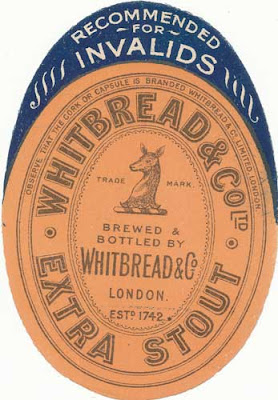
I've finally gotten around to photographing my other beer. SSS Stout from 1914.


It's not ready to drink just yet. To taste it at its best, I would recommend cellaring it for a few months. I'm going to try to hang on to some for a few years.

You should be able to read the details on the label. It's 9.99% ABV.